
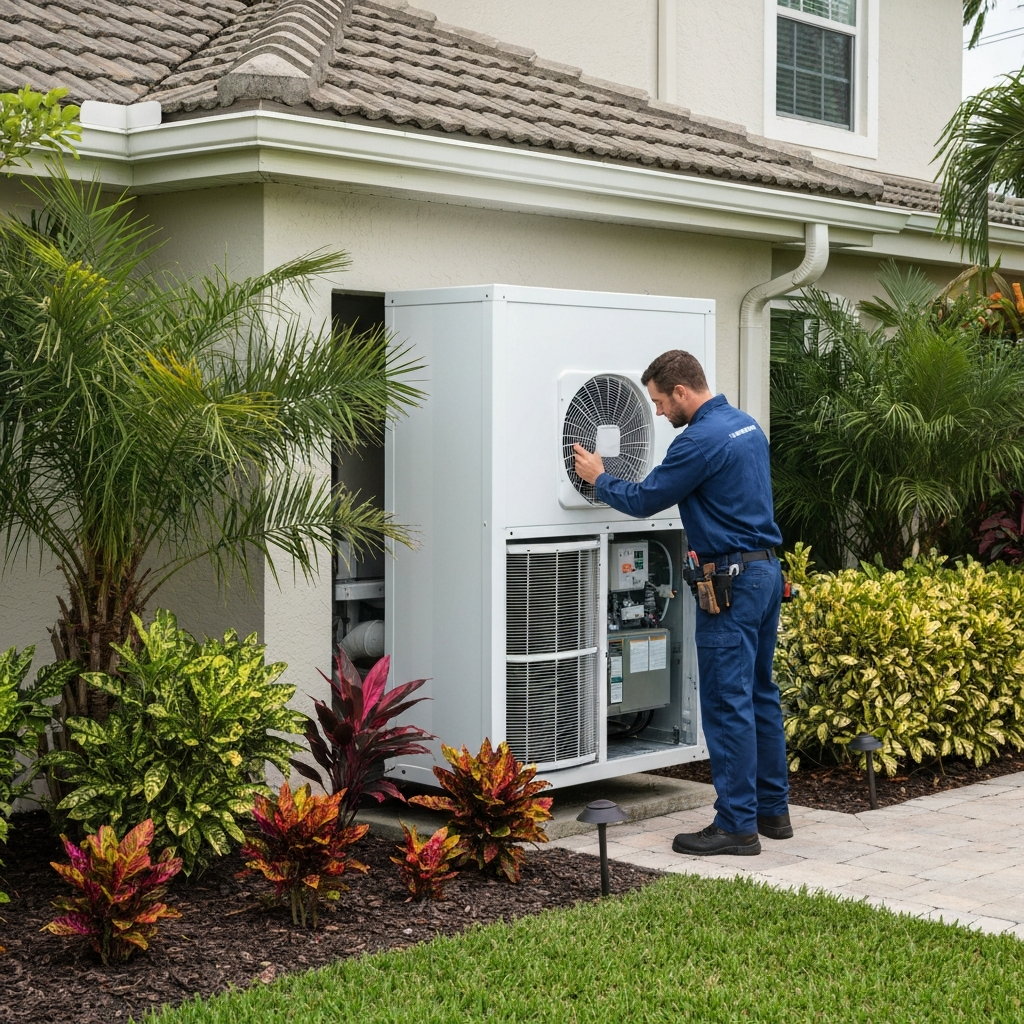
In Port Charlotte, Punta Gorda, North Port, Venice, Englewood, and Cape Coral, your air conditioning system isn't a seasonal appliance — it's a year-round necessity. The average Southwest Florida home runs its AC for 10–12 months of the year, putting enormous demand on components that might last 15+ years in a northern climate but often fail in 8–10 years here due to continuous use, salt air corrosion, and extreme heat. The good news: a disciplined HVAC maintenance routine can dramatically extend your system's life, reduce your monthly energy bills, and prevent the catastrophic mid-summer breakdowns that mean expensive emergency service calls and days without cooling in 95-degree heat.
Why Florida's Climate Is So Hard on HVAC Systems
Southwest Florida's combination of factors creates a uniquely demanding environment for HVAC systems. The outdoor condenser unit operates in direct sunlight and extreme heat, often with ambient temperatures of 90–100°F — conditions that force the compressor to work far harder than its design assumptions. Salt air from the Gulf of Mexico accelerates corrosion of aluminum fins, copper coils, and electrical connections, particularly within 5 miles of the coast — which includes most of Punta Gorda, Englewood, Venice, and Cape Coral. And the sheer volume of hours the system runs — 5,000–7,000 hours per year compared to 1,500–2,000 hours in northern states — accelerates wear on every mechanical component.
Understanding this context helps explain why preventive maintenance isn't optional in Florida — it's the difference between a 10-year system and a 15-year system, and between a $150 annual tune-up and a $5,000–$12,000 emergency replacement in the middle of August.
1. Air Filter Replacement: The Most Important and Most Ignored Task
A dirty air filter is the single most common cause of HVAC inefficiency and premature failure in Florida homes. When the filter is clogged, airflow across the evaporator coil is restricted, causing the coil to freeze — ironically, your AC stops cooling because it's working too hard. Frozen coils lead to water damage in the air handler cabinet and can damage the compressor over time.
- Replace 1-inch filters every 30 days in Florida — the combination of constant operation and high pollen/dust loads means monthly replacement is necessary, not the 90-day intervals recommended in cooler climates
- For 4–5 inch media filters, replace every 6 months, or more frequently if you have pets or allergy sufferers in the home
- Use MERV 8–11 rated filters for the best balance of filtration and airflow. MERV 13+ filters can restrict airflow too much in older systems
- Consider a UV air purification system mounted in the air handler to eliminate mold spores and bacteria from the airstream — particularly valuable in Florida's humid environment
- Check that your filter is properly seated with no gaps around the edges — bypass airflow around the filter is as damaging as no filter at all
2. Condensate Drain Line: Florida's Most Overlooked Maintenance Task
Your air handler removes humidity from indoor air by condensing it on the evaporator coil, and that water drains through a condensate line — typically a PVC pipe that exits through a wall or into a floor drain. In Florida's humid environment, your AC can remove 20–40 gallons of water per day, making this drain line absolutely critical. Algae and slime build up inside the line quickly in warm conditions, causing blockages that result in water backing up and overflowing the drain pan.
A clogged condensate line is one of the most common causes of water damage in Florida homes — flooding the air handler cabinet, saturating ceiling drywall below (in attic-mounted units), or flooding utility rooms. Every homeowner in Port Charlotte and Southwest Florida should:
- Pour 1/4 cup of white vinegar into the condensate drain access port monthly during the summer cooling season — this kills algae and prevents blockages
- Confirm your drain line has a secondary float switch that shuts off the AC if the primary line blocks and the drain pan fills — this is code-required in Florida but missing in many older systems
- Inspect the drain pan visually every few months for standing water, rust, or algae buildup
- Have your HVAC technician flush the condensate line with nitrogen or a wet/dry vac during annual service
- If your air handler is in the attic, ensure the secondary drain line exits visibly (over a window or soffit) so you can see if it's draining — which indicates a primary line blockage
Charlotte County Homeowner Tip: Pre-Summer Service
Schedule your annual HVAC tune-up in March or April — before the summer heat arrives and HVAC companies are overwhelmed with emergency calls. During the busy June–September season, technician availability drops and service costs rise. A spring tune-up ensures your system is fully ready before it faces its most demanding months.
3. Outdoor Condenser: Cleaning and Protecting Against Florida's Elements
The outdoor condenser unit works by pulling in ambient air, running it over coils containing hot refrigerant, and exhausting the heat upward through a fan. For this process to work efficiently, the condenser coils must be clean and unobstructed. In Florida's environment, condenser coils are exposed to:
- Grass clippings, seed pods, and debris from landscaping that clog the fins and restrict airflow — clean the area around the condenser after every lawn service
- Salt air corrosion that degrades aluminum fins and copper tubing over time — for coastal properties in Englewood, Venice Beach, or Cape Coral's waterfront areas, a protective fin coating applied during annual service can extend coil life by years
- Overgrown vegetation — maintain 18–24 inches of clearance around all sides of the condenser unit. Florida's rapid plant growth means this needs checking monthly during the growing season
- Landscaper damage — string trimmers can destroy condenser fins in seconds. Install a protective guard or mark the unit clearly to prevent accidental damage
- Pest intrusion — fire ants, lizards, and insects can nest in condenser cabinets and damage electrical components
4. Ductwork Inspection and Sealing
In Florida homes, ductwork is often located in the attic — one of the harshest possible environments. Attic temperatures in Southwest Florida can reach 140–160°F in summer, and ducts that are poorly insulated, improperly sealed, or partially disconnected waste enormous amounts of conditioned air. Studies by the Florida Solar Energy Center have found that the average Florida home loses 20–30% of its conditioned air through duct leaks.
Signs of duct problems include rooms that are consistently warmer or cooler than others, unusually high electric bills despite a functioning system, and excessive dust on registers and grilles. A professional duct inspection and sealing — using mastic sealant rather than duct tape, which fails in high-heat attics — can deliver immediate and measurable energy savings.
5. Your Annual HVAC Maintenance Checklist for Florida
A comprehensive annual HVAC service appointment for a Southwest Florida home should include:
- Check refrigerant charge and inspect for leaks — low refrigerant is inefficient and illegal to ignore in Florida under EPA Section 608
- Clean evaporator and condenser coils
- Inspect and tighten all electrical connections, capacitors, and contactors
- Lubricate all moving parts including fan motors and bearings
- Check thermostat calibration and operation
- Measure system airflow and static pressure
- Flush and treat condensate drain line
- Inspect ductwork at the air handler for disconnections or damage
- Test safety controls including high-pressure and low-pressure switches
- Apply coil protection coating for coastal properties
6. When to Replace: Signs Your Florida AC is at End of Life
Even with excellent maintenance, HVAC systems in Southwest Florida typically need replacement at 10–12 years. Key indicators that replacement is more economical than repair include:
- Refrigerant type: If your system uses R-22 (Freon), it was manufactured before 2010 and R-22 is now unavailable for purchase. Any leak means replacement is necessary
- Multiple compressor failures or refrigerant leaks in consecutive years
- SEER rating below 14 — Florida's climate means the payback on a high-efficiency system (16+ SEER) is typically 3–5 years through energy savings
- Heat exchanger cracks (in heat pump systems) — a safety hazard that typically warrants full system replacement
- Repeated repairs totaling more than 50% of replacement cost within 12 months
Planning an HVAC Replacement or Home Upgrade in Southwest Florida?
When your HVAC replacement is part of a broader home renovation — adding a room, finishing a garage, or reconfiguring your floor plan — Vong Home Remodeling, Inc. coordinates with licensed HVAC subcontractors and manages the full scope of work. Serving Port Charlotte, Punta Gorda, North Port, Venice, Englewood, and Cape Coral.