
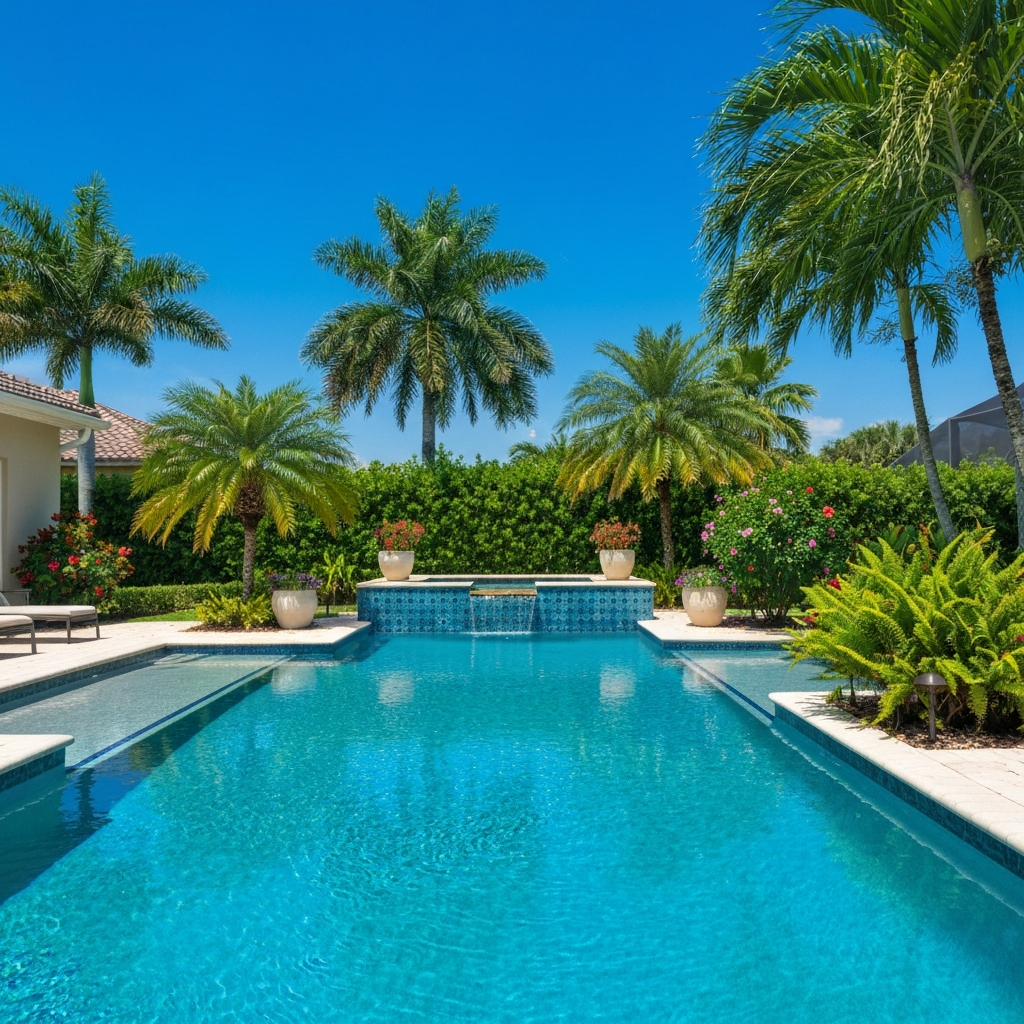
A backyard swimming pool is practically a rite of passage for homeowners in Port Charlotte, Punta Gorda, Cape Coral, North Port, Venice, and Englewood. With an average of 270 sunny days per year in Southwest Florida, pools here aren't a seasonal amenity — they're used nearly every month. But Florida's climate that makes pools so appealing also makes them more demanding to maintain than pools in any other region of the country. Intense UV radiation, high temperatures, frequent rain, and abundant organic material from tropical landscaping create a constant chemical and mechanical challenge. This guide from Vong Home Remodeling, Inc. covers everything you need to know to keep your pool safe, beautiful, and cost-effective year-round.
Why Florida Pools Require More Maintenance Than Northern Pools
Pool chemistry is driven by temperature, sunlight, and swimmer load. In Southwest Florida's climate, all three are maximized. Warmer water accelerates algae growth, promotes bacterial multiplication, and increases chlorine consumption. The intense UV from Florida's subtropical sun destroys unstabilized chlorine in hours rather than days. Heavy summer rains dilute chemicals and introduce phosphates and organic material that feed algae blooms. And frequent use — especially in family homes where pools are used almost daily — introduces body oils, sunscreen, and bacteria that demand continuous chemical management.
The consequence of inadequate pool maintenance in Florida isn't just a cloudy pool — it's the rapid development of algae blooms, which can turn a pool green overnight, damage pool surfaces, clog filters, and create slip hazards on steps and pool floors. Algae remediation, when a pool reaches this state, often requires superchlorination (shocking), multiple rounds of brushing and filtering, and chemical re-balancing over 3–7 days. Prevention is far less expensive than treatment.
1. Chemical Balance: The Foundation of Pool Maintenance
Maintaining proper chemical balance in a Florida pool requires more frequent testing than most manufacturers suggest. During summer (June through September), test your pool water at least twice per week. The target ranges for a healthy Florida pool are:
- Free Chlorine: 2.0–4.0 ppm. In Florida's heat and UV, aim for the higher end. Salt chlorine generators should be set to produce sufficient output for summer conditions — many homeowners set too low in winter and forget to adjust upward in spring.
- pH: 7.4–7.6. Florida's fill water (from Charlotte County Utilities or Cape Coral's municipal system) is typically alkaline, meaning pH tends to drift upward. Muriatic acid is the standard correction.
- Total Alkalinity: 80–120 ppm. This buffers pH swings and prevents the rapid pH changes that damage pool surfaces and equipment.
- Cyanuric Acid (Stabilizer): 40–80 ppm for traditional chlorine pools, 70–80 ppm for salt pools. This protects chlorine from UV degradation — without it, Florida's sun destroys your free chlorine within hours.
- Calcium Hardness: 200–400 ppm. Low calcium causes water to leach calcium from pool plaster and coping, leading to etching and rough surfaces. High calcium causes scaling on surfaces and equipment.
- Salt Level (salt pools): 2,700–3,400 ppm. Below this range, the salt cell cannot generate adequate chlorine. Test monthly and after heavy rain events that dilute the pool.
Charlotte County & Cape Coral: Watch Your Fill Water
Port Charlotte and Cape Coral both have high mineral content in their municipal water supply. When topping off your pool after evaporation (Florida pools lose 1–2 inches per week in summer), test the water after adding significant volume. Over time, repeated top-offs can elevate calcium hardness and total dissolved solids to levels that cloud the water and shorten equipment life. A professional water analysis every 3–4 months is worthwhile for pools in these areas.
2. Filtration: Your Pool's Circulatory System
Your pool's filter removes suspended particles, dead algae, and debris that chemical treatment kills but doesn't eliminate from the water. In Florida, filters work harder than anywhere else — heavy bather loads, frequent rain introducing debris, and palm and oak debris all tax the filtration system. The three main filter types each require different maintenance approaches:
- Sand Filters: Backwash when pressure gauge rises 8–10 psi above clean pressure, or every 2 weeks during heavy use season. Replace sand every 5–7 years — old sand loses filtration efficiency. Consider replacing with ZeoSand or glass media for better filtration.
- Cartridge Filters: Remove and rinse cartridges monthly in Florida (vs. quarterly in cooler climates). Soak in filter cleaner quarterly to remove oil and scale. Replace cartridges when cleaning no longer restores adequate flow.
- DE (Diatomaceous Earth) Filters: Backwash and add fresh DE when pressure rises. Perform a complete teardown and cleaning every 6 months in Florida. DE filters provide the finest filtration but require more hands-on maintenance.
Run your circulation pump a minimum of 8 hours per day in winter and 10–12 hours per day during Florida's hot summer months. Many pool owners in Port Charlotte and Punta Gorda are now upgrading to variable-speed pumps, which use dramatically less electricity than single-speed pumps and qualify for Florida Power & Light rebates. The energy savings typically pay for the pump upgrade within 18–24 months.
3. Pool Surface and Coping: Protecting Your Investment
Pool surfaces — plaster, pebble, tile, or vinyl liner — deteriorate faster in Florida's climate than in cooler, less sunny regions. UV exposure, the chemical demands of year-round use, and Florida's naturally aggressive water chemistry all contribute to surface wear. Key maintenance practices for pool surfaces include:
- Brush the entire pool surface weekly with a nylon brush (for plaster/pebble) or soft brush (for vinyl/fiberglass). This disrupts algae before it can establish itself and distributes chemicals evenly.
- Maintain proper calcium hardness — below 200 ppm, water becomes aggressive and leaches calcium from plaster surfaces, causing etching, roughness, and eventual delamination
- Address calcium scaling promptly — white deposits on tile at the waterline indicate high calcium. Use a pumice stone for tile, and consult a pool professional for severe scaling on plaster surfaces
- Inspect coping and decking annually for cracks, lifting, or deterioration. In Florida's shifting sandy soil, deck movement is common and can create trip hazards and water intrusion pathways
- Re-plaster or resurface plaster pools every 10–15 years. Pebble finishes typically last 15–25 years. In Florida's environment, plan toward the shorter end of these ranges.
4. Pool Equipment: Pumps, Heaters, and Salt Cells
Florida pools present equipment with unique challenges beyond the standard wear of operation. Salt chlorine generators — extremely popular in Southwest Florida due to the reduced need to handle chlorine chemicals — require annual salt cell inspection and cleaning. Scale deposits on the cell plates reduce chlorine output and shorten cell life. Inspect the cell every 3–4 months by removing it from the housing and examining the plates.
Pool heaters, while used less in Florida than in cooler climates, are still valuable for the 3–4 winter months when water temperatures drop below comfortable swimming range for most residents. Heat pump pool heaters are the most energy-efficient option for Florida's climate. Inspect the heater annually for corrosion, particularly at copper connections, and ensure the area around it is clear of vegetation. In salt pool installations, ensure the heater is installed downstream of the salt cell to prevent titanium-unfriendly salt water concentrations.
5. Hurricane Prep and Post-Storm Pool Recovery
Every hurricane season, Port Charlotte, Punta Gorda, and the wider Southwest Florida area faces the possibility of storm impact on pool systems. Before a named storm approaches:
- Do NOT drain your pool before a storm — an empty pool can float out of the ground in saturated soil conditions, causing catastrophic structural damage
- Lower the water level by 6–12 inches to allow for expected rainfall without overflow
- Remove all loose items from the pool deck and store them safely — furniture, toys, and equipment become dangerous projectiles in high winds
- Shut off electrical breakers to pool equipment to protect from power surges during the storm
- After the storm, do not run equipment until you've confirmed there is no flood damage or debris in the pump and filter
Post-storm pool recovery involves removing all debris, testing and rebalancing chemistry (storms dramatically alter pH and alkalinity), superchlorinating to address bacterial contamination, and running the filter continuously until the water clears. Expect to add significant chemicals after any major storm event, and be prepared for 3–5 days of recovery before the pool is safe for swimming.
6. Pool Enclosure Maintenance: Florida's Unique Consideration
Pool enclosures — the aluminum-framed screen structures that cover most Southwest Florida pools — provide enormous benefits: keeping out insects, reducing debris load, slowing evaporation, and allowing enjoyment of the pool during evening hours. But they require maintenance to remain effective and safe:
- Inspect screen panels annually for tears, holes, and deteriorating spline. Florida's UV degrades screening material over 5–7 years — complete re-screening is necessary at that interval
- Inspect the aluminum frame for corrosion, particularly at joints and ground-level connections. Touch up with aluminum-safe paint to prevent further oxidation
- After any storm, inspect all screws and fasteners and re-tighten or replace as needed. Wind loads stress the frame connections over time
- Clean screening annually with a soft brush and garden hose to remove mold, mildew, and algae that accumulate in Florida's humid environment
- Have a structural engineer or licensed contractor evaluate the enclosure before and after major storms — enclosure failures during hurricanes are common and can damage the pool structure beneath
Planning a Pool Area Renovation in Southwest Florida?
From pool deck resurfacing and coping replacement to full outdoor living space renovations — including new lanais, covered patios, summer kitchens, and enclosure upgrades — Vong Home Remodeling, Inc. transforms backyards throughout Port Charlotte, Punta Gorda, North Port, Venice, Englewood, and Cape Coral.